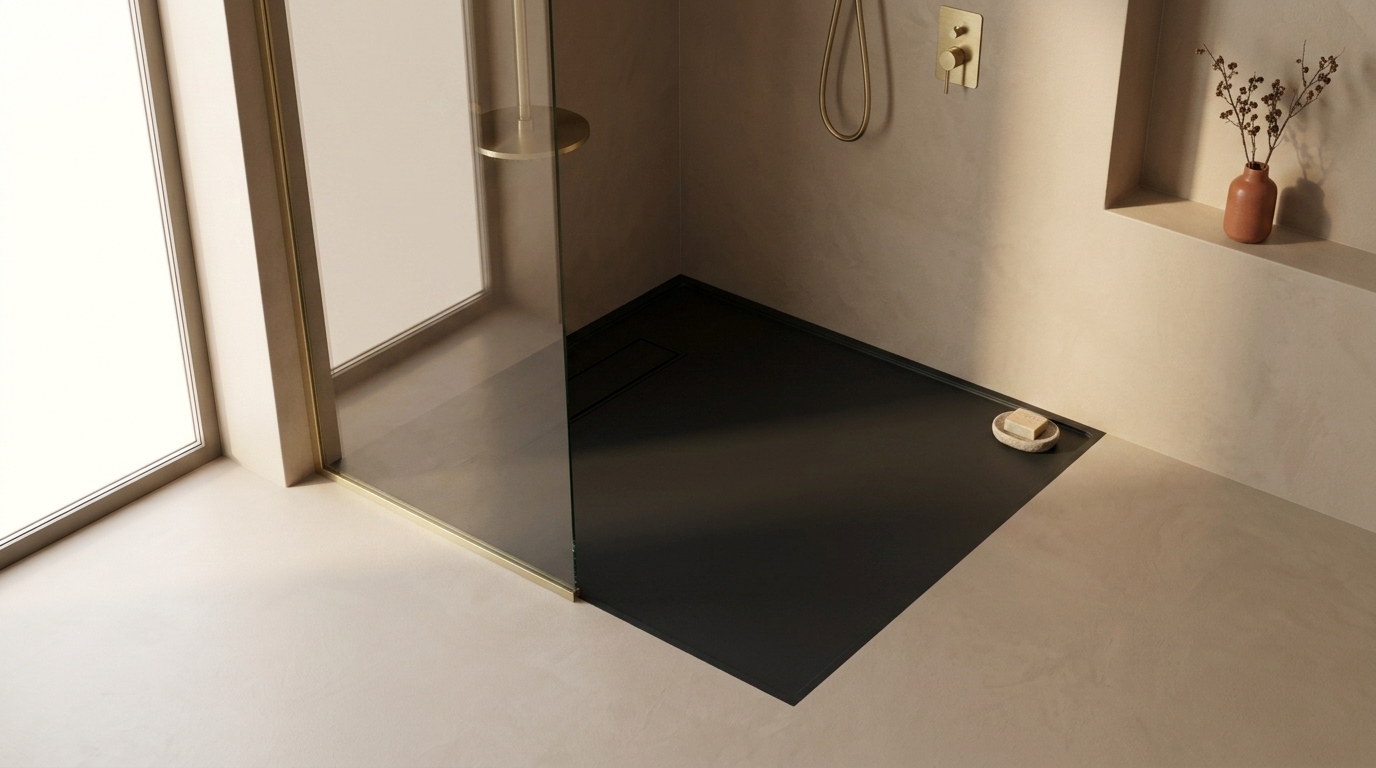
If you are choosing a made-to-measure shower tray, you will quickly run into two materials that sound almost identical: solid surface and mineral cast. They are related, but they are not the same — and the difference matters most on the day something goes wrong, not on the day you install it.
This guide explains both materials honestly. We make our shower trays in solid surface, so we have a clear preference, but mineral cast is a sensible choice for plenty of bathrooms — and we will say so where that is true.
The short answer
Mineral cast is a moulded mineral body with a coloured gelcoat layer on top. It looks great when new and usually costs less. The colour and finish live in that surface coating, so deep scratches or chips that break through the coat are hard to repair invisibly.
Solid surface (a mineral composite) is colour-through: the same material runs through the full 24 mm thickness. There is no separate coating to wear through, so scratches and dull spots can usually be sanded out and the tray repaired over its lifetime.
So the real question is not "which is better" in the abstract — it is how long you want the tray to keep looking new, and how much you are willing to spend for that.
What is mineral cast?
Mineral cast (sometimes sold as "mineral marble" or "cast marble") is made by mixing mineral fillers with a resin binder and pouring the mixture into a mould. Once it sets, the visible face is finished with a gelcoat — a thin, pigmented resin layer that gives the tray its colour, gloss and smoothness.
That gelcoat is the key to understanding mineral cast. It is what you see and touch, and it gives the material its clean, even look. But because the colour lives in that top layer rather than throughout the body:
- A deep scratch, chip or burn that cuts through the gelcoat exposes the duller mineral body underneath.
- Repairs to the gelcoat are possible but rarely invisible; matching colour and gloss is difficult.
- Over years of cleaning, some gelcoats can lose their gloss or, with certain resins, yellow slightly under heavy UV exposure or harsh chemical cleaners.
None of this makes mineral cast a poor product. For many showers it is perfectly fine, it feels solid underfoot, and the lower price is real. It is simply a coated material, and coatings behave differently from solid ones.
What is solid surface / mineral composite?
Solid surface — the mineral composite we use — is also a blend of mineral fillers and resin, but it is homogeneous: the same material, with the same colour, runs through the entire 24 mm thickness. There is no gelcoat sitting on top, because the surface and the core are one and the same.
This homogeneity is where its practical advantages come from:
- Colour-through. A scratch reveals the same colour underneath, so it is far less visible in the first place.
- Repairable. Light scratches and dull spots can typically be sanded and re-finished by hand, restoring the look without replacing the tray. A cigarette burn or scuff is a maintenance job, not a disaster.
- Seamless one-piece construction. Our trays are made in one piece, with the fall (slope) built in at the factory and a colour-matched drain cover, so there are no joints to fail and no separate frame.
- Warm, matte feel. A fine microtexture and a rounded R2 edge give a slip-resistant, pleasant surface that is matte rather than high-gloss.
It is a more involved material to manufacture, which is part of why it sits at a higher price point than basic mineral cast.
Comparison table
| Criterion | Mineral cast (gelcoat) | Solid surface (mineral composite) |
|---|---|---|
| Construction | Mineral body + pigmented gelcoat coating | Homogeneous, colour-through full thickness |
| Repairability | Hard to repair invisibly; gelcoat damage exposes the body | Light scratches and dull spots can be sanded and re-finished |
| Scratch visibility | More visible — different colour beneath the coat | Less visible — same colour all the way through |
| Yellowing / gloss loss over time | Possible on some gelcoats under UV or harsh cleaners | Low risk; colour is in the body, not a coating |
| Surface feel | Often glossier and smooth | Matte microtexture, warm, slip-resistant (rounded R2 edge) |
| Typical price | Lower | Higher |
| Best for | Budget-conscious projects, lighter use | Long lifespan, made-to-measure, repair over replace |
Both materials are waterproof and both can be produced made-to-measure. The differences above are about longevity and repair, not about whether the tray will keep water out.
And steel enamel?
Steel enamel (enamelled steel) is a third common option, and a different beast entirely. It is a pressed steel pan coated with a fired-on glass enamel. It is hard, hygienic and often inexpensive, with these trade-offs to weigh:
- The enamel is very scratch-resistant but brittle: a heavy impact can chip it, and once chipped the exposed steel can rust. Chips are difficult to repair.
- It feels cold and hard underfoot and can be noisier under running water.
- It comes in standard sizes and shapes; genuinely made-to-measure trays with cut-outs around walls or sloped ceilings are not really its domain.
If you want a low-cost standard rectangle and do not mind a colder, harder feel, steel enamel is a reasonable pick. For a custom shape or a warmer, repairable surface, it is the wrong tool.
Verdict
There is no single winner — it depends on what you are optimising for:
- Choose mineral cast if budget is the priority, the shower sees normal household use, and you are comfortable with a coated surface that is harder to repair later.
- Choose solid surface if you want the tray to keep looking new for many years, you are ordering a made-to-measure size or shape, and you value being able to repair the surface rather than replace the whole tray.
- Choose steel enamel only if you specifically want a hard, glassy, low-cost standard rectangle and the colder feel does not bother you.
We build our shower trays in solid surface for exactly the reasons above: colour-through material, seamless one-piece construction, a built-in fall, and a surface you can maintain over its lifetime. That said, the honest answer is the one that fits your bathroom — if a simple, lower-cost tray is all you need, mineral cast will serve you well.
Price & delivery
Our solid surface shower trays run from €684 to €1,018 incl. VAT for standard sizes with the solid-surface drain cover (from €534 with a plain Ø 90 mm drain hole), and made-to-measure trays start from €695 incl. VAT (plus shipping). There is no online payment: you receive an order confirmation and a payment request, with a deposit of at most 50%. For made-to-measure orders we first send a production drawing for your approval. Lead time is approximately six weeks, with delivery across Europe — made in our own workshop in the Netherlands, direct from the manufacturer.